



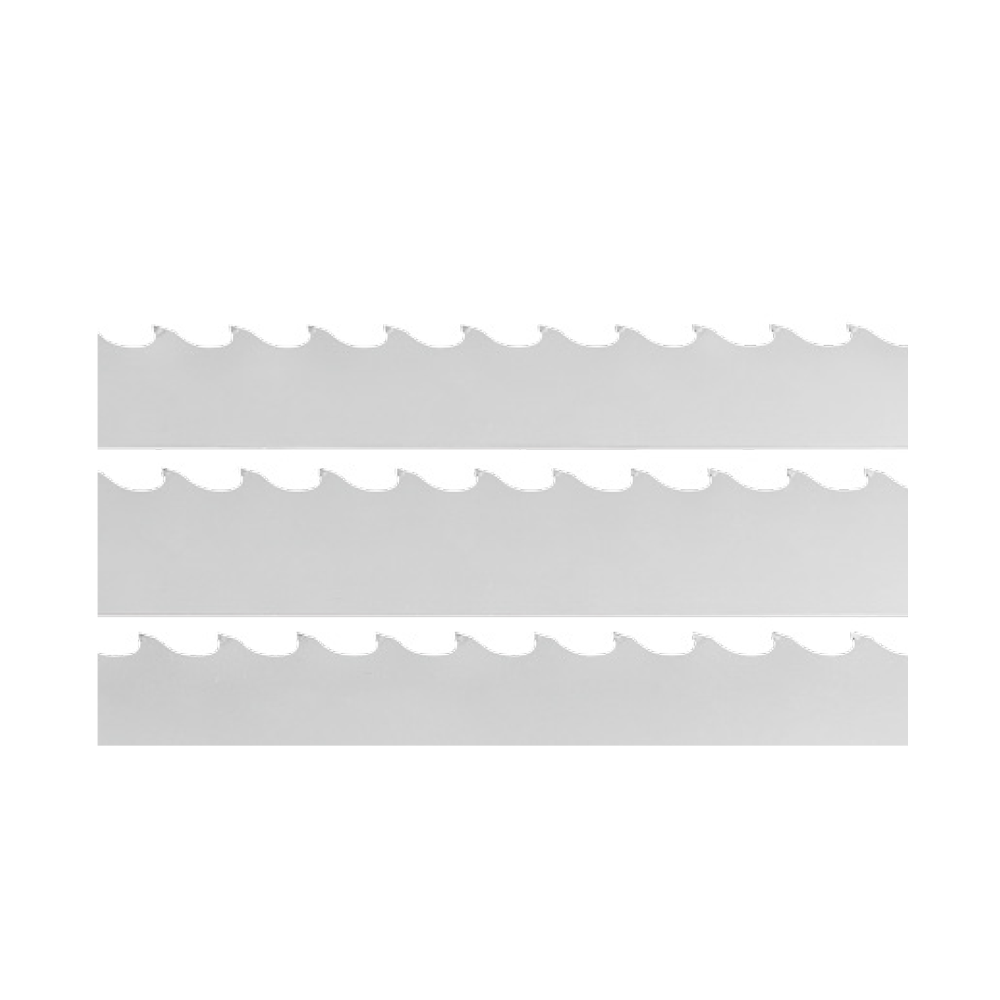
Band Saw Blades are continuous loop cutting tools manufactured from high-quality alloy steel or bi-metal materials, providing excellent flexibility, fatigue resistance, and durability. They are suitable for straight and contour cutting applications in woodworking, metal fabrication, furniture production, and steel processing industries. A wide range of tooth pitches, tooth profiles, and blade widths are available to accommodate various material thicknesses and hardness levels. With narrow kerf width and efficient material utilization, band saw blades help reduce material waste while improving cutting precision and operational productivity.

How to Optimise Metal Cutting with the Right Band Saw Blade?
Choosing the Right Band Saw Blades for Metal Work
Anyone who spends time around a metal shop knows that picking a blade isn't just about grabbing whatever fits the machine. The material you cut, the shape of the workpiece, and even the type of saw you run all affect which band saw blades actually work. This guide goes through what these blades are, how different designs behave, where you'd use each type, and a straightforward comparison to help you decide between common options like steel saw blade variants and bandsaw blades for metal cutting.
What We Mean by Band Saw Blades for Metal
A band saw blade is essentially a long strip of metal with teeth on one edge, joined at the ends to form a loop. That loop spins around two wheels, and the moving teeth do the cutting. When people talk about it for metal, they're referring to blades designed to handle ferrous or non‑ferrous metals without losing their edge too fast. These blades have to manage heat, vibration, and the physical stress of cutting through something hard.
How They're Built and Why That Matters
Tooth geometry drives how aggressively or smoothly a blade cuts. There isn't one perfect geometry for all jobs.
- Raker tooth: Uses a repeating pattern of left‑set, right‑set, and straight teeth. It gives a nicer surface finish, which helps when working with thinner metals where appearance matters.
- HP (High Penetration) tooth: More aggressive, with a steeper positive rake. This one digs into harder steels and alloys faster, though it leaves a rougher finish.
- IC (Intermediate Cutting) tooth: Sits somewhere between raker and HP. It's a common choice for structural steel and general shop cutting.
- Skip tooth: Teeth are spaced further apart, with shallow gullets. Good for non‑ferrous metals like aluminium or brass, because those materials don't pack into the gullet as easily.
Then there's the blade material itself. A steel saw blade could be carbon steel, bi‑metal, or carbide‑tipped, and each behaves differently.
Carbon steel blades are simple and cheap. They cut soft metals –aluminium, copper, brass – okay for a while. But hit harder steel with one, and it dulls fast. Most shops keep a few carbon blades around for occasional non‑ferrous work, but not for daily metal cutting.
Bi‑metal blades are the workhorse. They have a high‑speed steel (HSS) tooth edge welded onto a flexible alloy steel back. The HSS stays sharp under heat, and the flexible back bends around the saw wheels without cracking. Hardness runs around 67‑69 Rockwell C. These handle most mild steel, structural steel, stainless, and aluminium up to about 45 Rockwell.
Carbide‑tipped blades take things further. Tungsten carbide teeth brazed to a steel backing give hardness near 100 Rockwell C and heat tolerance up to roughly 1,000°C. They cut hardened steels, titanium, Inconel – materials that would kill a bi‑metal blade in minutes. They cost more, and they need a rigid, vibration‑free saw to work properly.
Where You Actually Use Each Type
- Mild steel and structural steel – Bi‑metal blades with 6‑10 TPI handle solid bar easily. For thin‑wall tubing in mild steel, move up to 14‑18 TPI so the teeth don't strip.
- Stainless steel – This material works harder and wears down bi‑metal blades faster. Carbide‑tipped blades are the better choice for solid stainless stock. For stainless sheet metal, 18‑24 TPI works fine with a bi‑metal blade if you aren't cutting all day.
- Aluminium and other non‑ferrous metals – Carbon steel or bi‑metal works here. Thick aluminium (over 6 mm) takes 6‑10 TPI. Thialuminiumum or sheet uses 14‑24 TPI. Aluminium cuts easily, so you can run higher speeds than with steel.
- Pipes, tubes, angle iron, I‑beams – These shapes test a blade differently because the cut depth changes as the blade moves through the profile. Bi‑metal blades on a horizontal or vertical band saw are common for carbon steel, aluminium, stainless steel, pipes, bolts, die steel, and flat stock.
- High‑alloy and exotic materials – Titanium, Inconel, Hastelloy, other nickel alloys – these demand carbide‑tipped blades. Bi‑metal just won't last. The higher upfront cost pays off when you aren't changing blades every few cuts.
keep in touch
-
We are committed to providing durable, reliable, and efficient cutting solutions for global B2B clients and partners.
-
Useful Links
Home Products About Us Manufacturing Custom Service News Contact Us -
Contact Us
+86-579-89270208
+86-579-89270636ch001@changhengsaws.comNo. 102, Huacheng East Road, Chengxi Industrial Zone, Yongkang, Zhejiang, China -
Mobile Web
